Difference Between Oz and Fl Oz (Quick Answer)
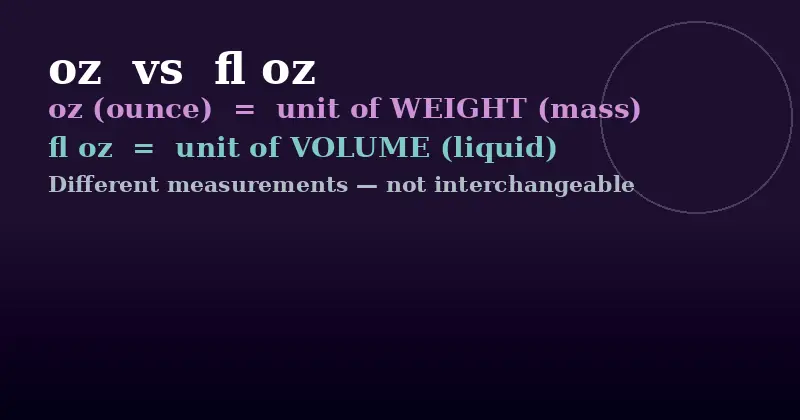
The difference between oz and fl oz comes down to one fundamental distinction: what they measure.
- oz (ounce) — measures weight or mass. It tells you how heavy something is.
- fl oz (fluid ounce) — measures volume. It tells you how much space a liquid occupies.
Both use the word "ounce," which is the source of nearly all the confusion. They are related historically — both trace back to the Roman unit uncia — but in modern measurement, they represent two completely different physical quantities. You cannot substitute one for the other without knowing the density of the substance you are measuring.
Fluid Ounce vs Ounce Explained Simply
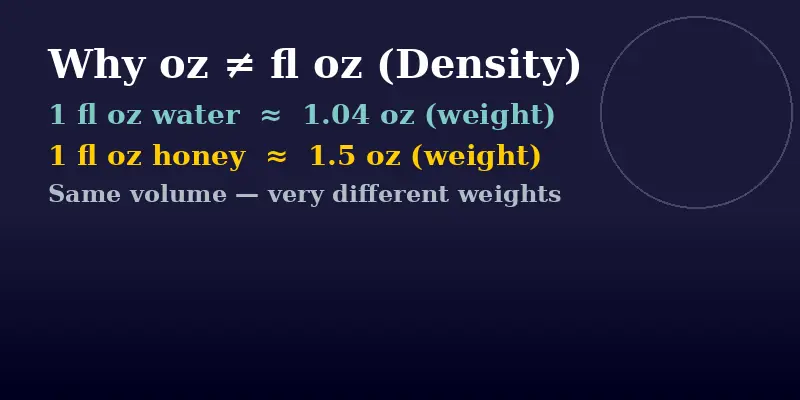
Imagine two identical containers, each labelled "1 oz." If the first contains water and the second contains honey, they hold the same volume (1 fl oz each) but very different weights. The water container weighs about 1.04 oz; the honey container weighs about 1.5 oz. Same fl oz — different oz. That is the essence of the fl oz vs oz distinction.
| Property | oz (Ounce) | fl oz (Fluid Ounce) |
|---|---|---|
| Measures | Weight / mass | Volume (liquid) |
| System | US customary / imperial | US customary / imperial |
| US value | 1 oz = 28.3495 grams | 1 fl oz = 29.5735 mL |
| Used for | Flour, sugar, butter, meat, cheese | Water, milk, juice, oil, broth |
| Measured with | Kitchen scale | Measuring cup or jug |
| Interchangeable? | Only for water (approximately) — not for other substances | |
Oz vs Fl Oz in Cooking and Recipes
This distinction matters most in the kitchen. Misreading oz for fl oz — or vice versa — in a recipe produces results that range from slightly off to completely wrong, especially in baking where precision is critical.
When Recipes Say "oz"
When a recipe lists an ingredient as "8 oz of flour" or "4 oz of butter," it is asking for weight. You need a kitchen scale. Eight ounces of flour by weight is approximately 227 grams. If you try to measure 8 fl oz of flour using a liquid measuring cup, you will end up with much less than the recipe intended — because a cup of flour (8 fl oz by volume) typically weighs only about 4.5–5 oz by weight due to how loosely flour packs.
When Recipes Say "fl oz"
When a recipe lists "8 fl oz of milk" or "4 fl oz of olive oil," it is measuring by volume. Use a liquid measuring cup marked in fl oz. These measurements are the same regardless of what the liquid is — 8 fl oz of water and 8 fl oz of heavy cream occupy the same volume, even though the cream weighs more.
The Ambiguous Case
Many American recipes simply write "oz" even for liquids — for example, "8 oz of chicken broth." In most cases, liquid ingredients written as "oz" in American recipes actually mean fluid ounces (volume), because US home cooks traditionally measure liquids by volume. Context matters: if the ingredient is a liquid, "oz" usually means "fl oz."
Weight vs Volume Measurement
Understanding the conceptual difference between weight and volume removes the confusion permanently:
- Weight (oz) answers the question: "How heavy is it?" It is measured on a scale and expressed in ounces, pounds, or grams. Weight depends on both the amount of material and its density.
- Volume (fl oz) answers the question: "How much space does it take up?" It is measured in a graduated container and expressed in fl oz, cups, millilitres, or litres. Volume tells you about space, not mass.
The reason liquids are almost always measured by volume in recipes is practicality: it is much faster to pour water into a measuring jug than to weigh it on a scale. However, professional bakers and chefs increasingly prefer weight-based measurements for dry ingredients because weight is more accurate and consistent regardless of how tightly or loosely an ingredient is packed.
For volume conversions between fl oz and other liquid units, see our complete oz to liter converter and the liquid measurement conversion chart.
When to Use Oz and When to Use Fl Oz
Use oz (weight) when:
- Measuring dry ingredients — flour, sugar, oats, nuts, dried fruit
- Measuring solid fats — butter, lard, solid coconut oil
- Measuring meat, fish, or poultry
- Reading a nutrition label showing serving size by weight
- Checking a postage or shipping weight
- Weighing precious metals (which use a different troy ounce system)
Use fl oz (volume) when:
- Measuring any liquid — water, milk, juice, broth, wine, oil
- Reading a beverage container label (all US beverage containers use fl oz)
- Converting liquid volumes to gallons, litres, or millilitres
- Following a recipe that lists liquid ingredients
- Using our oz to gallon converter — all values are fl oz
Common Mistakes People Make
Mistake 1 — Treating Oz and Fl Oz as Identical
The most common mistake is assuming that because a food scale shows "8 oz" and a measuring cup shows "8 fl oz," both containers hold the same amount of the same ingredient. For water, this is close enough to cause no harm. For denser liquids like honey, maple syrup, or oil, the difference is significant enough to affect recipe outcomes.
Mistake 2 — Reading Beverage Labels as Weight
A 16.9 fl oz water bottle does not weigh 16.9 oz. It actually weighs approximately 17.6 oz (500 grams) once filled, because water is slightly denser than 1 fl oz = 1 oz. The bottle itself adds further weight. The "16.9 fl oz" label is volume only.
Mistake 3 — Using a Liquid Measuring Cup for Dry Ingredients
Measuring 1 cup (8 fl oz) of flour by volume gives you approximately 4.25–4.5 oz of flour by weight — not 8 oz. Recipes that specify weight require a scale, not a volume measuring cup. This is the single most common source of baking failures when switching between American volume recipes and European weight-based recipes.
Mistake 4 — Confusing UK and US Labelling
In the UK, product labels often show fluid ounces alongside metric values, but they are imperial fl oz (28.41 mL each), not US fl oz (29.57 mL each). A UK label reading "10 fl oz" does not equal 10 US fl oz — it is about 283 mL, while 10 US fl oz is 296 mL.
Conversion Examples — Water, Milk, Flour, and Oil
These examples show how the oz vs fl oz distinction plays out with four common kitchen ingredients. Each example uses 1 fl oz of volume and shows the corresponding weight in ounces:
| Ingredient | Volume | Weight (oz) | Weight (grams) | Notes |
|---|---|---|---|---|
| Water | 1 fl oz | ~1.04 oz | ~29.6 g | Closest to 1:1 ratio |
| Whole milk | 1 fl oz | ~1.07 oz | ~30.5 g | Slightly denser than water |
| Olive oil | 1 fl oz | ~0.96 oz | ~27.2 g | Lighter than water |
| Honey | 1 fl oz | ~1.50 oz | ~42.5 g | Much denser than water |
| Heavy cream | 1 fl oz | ~1.01 oz | ~28.7 g | Very close to water |
| All-purpose flour | 1 fl oz (by vol.) | ~0.56 oz | ~16 g | Much lighter — always weigh flour |
| White sugar | 1 fl oz (by vol.) | ~0.75 oz | ~21 g | Lighter than water by volume |
Why Fluid Ounces and Ounces Are Not Always Equal
The reason oz and fl oz diverge for most substances is density — the amount of mass packed into a given volume. Density is expressed as mass per unit volume (e.g., grams per millilitre).
Water has a density of almost exactly 1 g/mL. Since 1 US fl oz = 29.5735 mL and 1 US oz = 28.3495 g, a fluid ounce of water weighs 29.5735 g, which is about 1.043 oz. For water only, fl oz and oz are therefore almost equal — differing by about 4%. This is close enough that many American cooks treat them as interchangeable for water, which is generally fine in cooking contexts.
For every other substance, density moves the weight-to-volume ratio away from near-equality:
- Substances denser than water (honey, corn syrup, salt water): 1 fl oz weighs more than 1 oz
- Substances less dense than water (oil, alcohol, air): 1 fl oz weighs less than 1 oz
This is why professional baking uses weight (oz or grams) for dry ingredients — you cannot reliably predict how much a cup of flour weighs without a scale, because it depends on how tightly it was packed.
US vs UK Fluid Ounce Differences
There is an additional layer of complexity: the fluid ounce itself is not standardised globally. The US fl oz and UK imperial fl oz are different sizes, which means "fl oz" on an American label and "fl oz" on a British label are not the same volume.
| Measurement | US Fluid Ounce | UK Imperial Fluid Ounce | Difference |
|---|---|---|---|
| Volume | 29.5735 mL | 28.4131 mL | US is ~4% larger |
| Per litre | 33.814 fl oz/L | 35.195 fl oz/L | — |
| Per gallon | 128 fl oz (3.785 L) | 160 fl oz (4.546 L) | UK gallon is 20% larger |
| Used in | United States | United Kingdom | — |
This difference rarely causes practical problems in everyday cooking because most recipes only come from one country at a time. However, when using international recipes or comparing product sizes across countries, confirming which fl oz definition applies matters. All volume conversions on this site use the US fluid ounce throughout.
For the full picture on how fl oz relates to gallons and litres in both systems, see: Liquid Measurement Conversion Chart.
The authoritative definitions of US fluid measurement units are maintained by the National Institute of Standards and Technology (NIST).