Oz to Ml Conversion Chart
This complete oz to ml chart covers the most commonly needed fluid ounce values — from a single ounce up to one full gallon. All values are based on the US fluid ounce (1 fl oz = 29.5735 ml):
| Fluid Ounces (fl oz) | Milliliters (ml) | Litres (L) | Common Equivalent |
|---|---|---|---|
| 0.5 oz | 14.79 ml | 0.015 L | 1 tablespoon |
| 1 oz | 29.57 ml | 0.030 L | 2 tablespoons |
| 2 oz | 59.15 ml | 0.059 L | ¼ cup |
| 3 oz | 88.72 ml | 0.089 L | — |
| 4 oz | 118.29 ml | 0.118 L | ½ cup |
| 5 oz | 147.87 ml | 0.148 L | — |
| 6 oz | 177.44 ml | 0.177 L | ¾ cup |
| 7 oz | 207.01 ml | 0.207 L | — |
| 8 oz | 236.59 ml | 0.237 L | 1 US cup |
| 10 oz | 295.74 ml | 0.296 L | 1¼ cups |
| 12 oz | 354.88 ml | 0.355 L | 1½ cups / soda can |
| 14 oz | 414.03 ml | 0.414 L | — |
| 16 oz | 473.18 ml | 0.473 L | 1 US pint |
| 20 oz | 591.47 ml | 0.591 L | Large soda bottle |
| 24 oz | 709.76 ml | 0.710 L | — |
| 32 oz | 946.35 ml | 0.946 L | 1 US quart |
| 40 oz | 1,182.94 ml | 1.183 L | — |
| 48 oz | 1,419.53 ml | 1.420 L | — |
| 64 oz | 1,892.71 ml | 1.893 L | ½ gallon |
| 96 oz | 2,839.06 ml | 2.839 L | ¾ gallon |
| 128 oz | 3,785.41 ml | 3.785 L | 1 US gallon |
Need the gallon equivalent of any of these values? Use our oz to gallon converter for instant results.
Ml to Oz Conversion Chart
Working in the other direction — converting milliliters to fluid ounces — is equally common, especially when following metric recipes or reading international product labels:
| Milliliters (ml) | US Fluid Ounces (fl oz) | Common Equivalent |
|---|---|---|
| 5 ml | 0.17 fl oz | 1 teaspoon |
| 10 ml | 0.34 fl oz | 2 teaspoons |
| 15 ml | 0.51 fl oz | 1 tablespoon |
| 30 ml | 1.01 fl oz | ~1 fl oz / 1 shot |
| 50 ml | 1.69 fl oz | Miniature bottle |
| 100 ml | 3.38 fl oz | Travel-size bottle |
| 150 ml | 5.07 fl oz | — |
| 200 ml | 6.76 fl oz | Small juice carton |
| 250 ml | 8.45 fl oz | 1 metric cup |
| 300 ml | 10.14 fl oz | — |
| 355 ml | 12.00 fl oz | Standard US soda can |
| 400 ml | 13.53 fl oz | — |
| 500 ml | 16.91 fl oz | Standard water bottle |
| 750 ml | 25.36 fl oz | Wine bottle |
| 1,000 ml (1 L) | 33.81 fl oz | 1 litre bottle |
| 1,500 ml | 50.72 fl oz | Large sparkling water |
| 2,000 ml (2 L) | 67.63 fl oz | 2-litre soda bottle |
How to Convert Oz to Ml
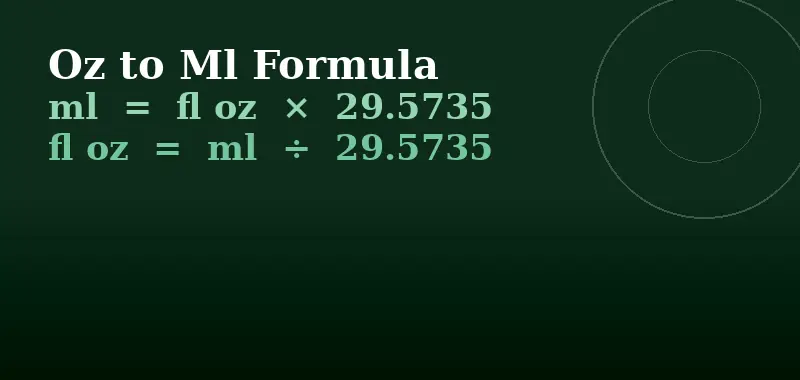
The oz to ml conversion uses one straightforward multiplication. The exact conversion factor for the US fluid ounce is:
Step-by-Step Examples
- 1 oz to ml: 1 × 29.5735 = 29.57 ml
- 4 oz to ml: 4 × 29.5735 = 118.29 ml
- 8 oz to ml: 8 × 29.5735 = 236.59 ml
- 16 oz to ml: 16 × 29.5735 = 473.18 ml
- 32 oz to ml: 32 × 29.5735 = 946.35 ml
- 64 oz to ml: 64 × 29.5735 = 1,892.71 ml
- 128 oz to ml: 128 × 29.5735 = 3,785.41 ml (1 gallon)
Quick Mental Estimate
For fast mental calculations, round 29.5735 up to 30. This gives you an estimate within about 1.5% accuracy — close enough for cooking, portioning, and everyday use.
- 4 oz × 30 = 120 ml (exact: 118.29 ml)
- 8 oz × 30 = 240 ml (exact: 236.59 ml)
- 16 oz × 30 = 480 ml (exact: 473.18 ml)
What Is a Fluid Ounce (oz)?
A fluid ounce (fl oz) is a unit of liquid volume in the US customary measurement system. The word "fluid" distinguishes it from the dry ounce, which measures weight rather than volume. When you see "fl oz" on a beverage label, medicine cup, or recipe, it always refers to volume.
Key facts about the US fluid ounce:
- 1 US fl oz = 29.5735 milliliters
- 1 US fl oz = 1/128 of a US gallon
- 1 US fl oz = 1/32 of a US quart
- 1 US fl oz = 2 tablespoons
- 8 US fl oz = 1 US cup
The fluid ounce appears on virtually every liquid product sold in the United States — from 12 oz soda cans to 64 oz juice jugs. For its gallon-based equivalents, see our oz to gallon converter. For litre-based conversions, see the oz to liter guide.
What Is a Milliliter (ml)?
A milliliter (ml) is a metric unit of liquid volume equal to one thousandth of a litre (1 ml = 0.001 L). It is the standard small-volume unit in the International System of Units (SI) and is used worldwide in science, medicine, cooking, and product labelling.
Key facts about the milliliter:
- 1 ml = 0.001 litres
- 1 ml = 1 cubic centimeter (cm³)
- 1,000 ml = 1 litre
- 1 ml ≈ 0.0338 US fl oz
- 250 ml = 1 metric cup
Because the US is one of the few countries that doesn't use metric as its primary everyday system, American products often display both measurements — for example, a water bottle labelled "16.9 fl oz (500 ml)." Understanding ml allows you to read any international product accurately.
US vs UK Fluid Ounce Differences
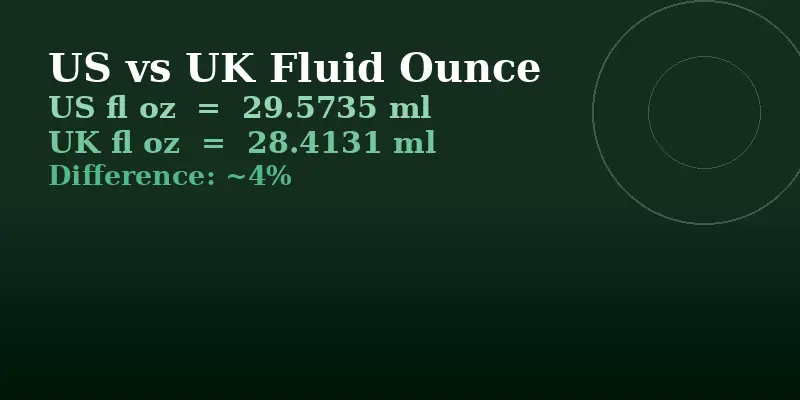
Not all fluid ounces are the same. The US fluid ounce and the UK imperial fluid ounce are distinct units — a fact that matters significantly when following British recipes, reading imported product labels, or comparing measurements across countries.
| Property | US Fluid Ounce | UK Imperial Fluid Ounce |
|---|---|---|
| ml equivalent | 29.5735 ml | 28.4131 ml |
| Fl oz per litre | 33.814 fl oz/L | 35.195 fl oz/L |
| Fl oz per gallon | 128 fl oz | 160 fl oz |
| Difference vs US | — | ~4% smaller |
| Used in | United States | United Kingdom |
In practice, the 4% difference between US and UK fluid ounces rarely matters for casual cooking. However, for precise baking, pharmaceutical dosing, or commercial food production, always confirm which fluid ounce definition the recipe or specification uses.
Note that the UK gallon also differs from the US gallon — the UK gallon = 160 imperial fl oz = 4.546 litres, versus the US gallon = 128 US fl oz = 3.785 litres. See the full breakdown in our guide: What Is Oz and How Many Liters in a Gallon?
Common Kitchen & Daily Conversions
The oz to ml conversion comes up constantly in cooking, baking, and daily beverage tracking. Here are the most practical reference values organised by context:
Cooking and Baking
- 1 teaspoon = 5 ml (≈ 0.17 fl oz)
- 1 tablespoon = 15 ml (≈ 0.51 fl oz)
- ¼ cup = 2 oz = 59.15 ml
- ½ cup = 4 oz = 118.29 ml
- 1 cup = 8 oz = 236.59 ml
- 2 cups (1 pint) = 16 oz = 473.18 ml
Beverages and Bottles
- Standard espresso shot: 1–1.5 oz = 30–44 ml
- Soda can (US): 12 oz = 355 ml
- Standard water bottle: 16.9 oz = 500 ml
- Wine bottle: 25.36 oz = 750 ml
- 1-litre bottle: 33.81 oz = 1,000 ml
- 2-litre bottle: 67.63 oz = 2,000 ml
Medicine and Health
- Typical liquid medicine dose: 5–10 ml (≈ 0.17–0.34 fl oz)
- Daily hydration goal (half gallon): 64 oz = 1,892.71 ml
- Daily hydration goal (full gallon): 128 oz = 3,785.41 ml
For water intake planning, see our full guide: How Many Water Bottles Make a Gallon?
Why the Oz to Ml Conversion Matters
Cooking Across International Recipes
Many recipes from the UK, Europe, and Australia use milliliters and litres exclusively. American home cooks following these recipes need to convert fl oz to ml fluently. A recipe calling for "200 ml of cream" translates to approximately 6.76 fl oz. Without the conversion, portioning is guesswork.
Product Labelling and Shopping
US products list volumes in fl oz. International products use ml. When comparing prices or nutritional content across brands from different countries, converting to a common unit — either ml or fl oz — is the only way to make a meaningful comparison.
Hydration Tracking
Fitness apps, nutritional labels, and hydration challenges mix metric and US measurements freely. If your daily water goal is set in litres (e.g., 2 litres) and your bottle is labelled in fl oz (e.g., 16.9 oz), converting between the two keeps your tracking accurate. Use our oz to liter converter for the full litre-based view.
Travel and International Use
Airport security rules (such as the 100 ml / 3.4 fl oz liquid limit for carry-on bags) require you to think in both units simultaneously. Knowing that 100 ml ≈ 3.38 fl oz — just under a third of a cup — makes packing and compliance straightforward.
For volume conversions beyond ml, see our gallon to oz calculator and the oz to quart converter.
The official SI definition of the milliliter is maintained by the Bureau International des Poids et Mesures (BIPM) — the global authority on measurement standards.