How Many Oz in a Gallon of Gas?
A US gallon of gas contains exactly 128 fluid ounces. Gasoline is a liquid, and like all liquids measured in the United States, it uses the US customary volume system — where 1 gallon equals 128 fl oz regardless of whether the liquid is water, milk, or fuel.
This means the oz-to-gallon conversion for gasoline is identical to any other liquid conversion. There is no special "fuel gallon" — the volume unit is the same standard US liquid gallon you encounter on grocery store labels and nutrition facts panels.
- 1 US gallon of gas = 128 fl oz
- 1 UK imperial gallon of fuel = 160 imperial fl oz
Use our free oz to gallon converter to calculate any fuel volume instantly, or the gallon to oz calculator to go in the other direction.
US vs UK Gallon for Gasoline
One of the most important distinctions in fuel measurement is the difference between the US gallon and the UK imperial gallon. They share the same name but are not the same volume — a fact that matters significantly when comparing fuel economy figures, pricing, or tank capacities across countries.
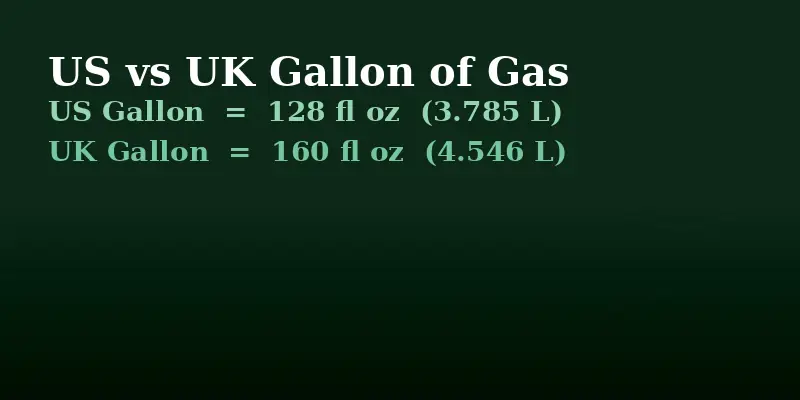
| Measurement | US Liquid Gallon | UK Imperial Gallon |
|---|---|---|
| Fluid Ounces | 128 fl oz | 160 imperial fl oz |
| Litres | 3.785 L | 4.546 L |
| Quarts | 4 quarts | 4 quarts (larger) |
| Difference | — | ~20% larger than US |
| Used in | USA, Liberia, Myanmar | UK, some Commonwealth nations |
This difference has a direct practical impact. If a UK car states fuel economy of "40 miles per gallon," that gallon is 160 oz — larger than the US gallon. The same car would achieve roughly 33 miles per US gallon. Always confirm which gallon definition applies when comparing fuel data across different countries.
Gasoline Gallon to Ounces Conversion Chart
This chart covers the most common fuel volume conversions — from a quart of gas all the way up to a 20-gallon tank. All values use the US liquid gallon standard:
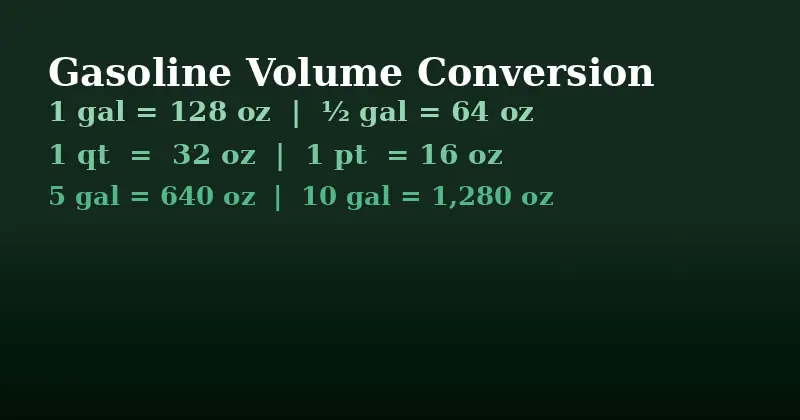
| US Gallons of Gas | Fluid Ounces (fl oz) | Litres (approx.) | Common Context |
|---|---|---|---|
| ¼ gal (1 quart) | 32 oz | 0.946 L | Small engine / mower tank |
| ½ gallon | 64 oz | 1.893 L | Chainsaw / generator refill |
| 1 gallon | 128 oz | 3.785 L | Standard portable fuel can |
| 2 gallons | 256 oz | 7.571 L | Small car refill |
| 3 gallons | 384 oz | 11.36 L | Motorcycle full tank |
| 5 gallons | 640 oz | 18.93 L | Standard jerry can |
| 10 gallons | 1,280 oz | 37.85 L | Mid-size car half tank |
| 15 gallons | 1,920 oz | 56.78 L | Average sedan full tank |
| 20 gallons | 2,560 oz | 75.71 L | SUV / truck full tank |
| 30 gallons | 3,840 oz | 113.6 L | Large truck / RV tank |
Conversion Formula: Fluid Ounces to Gallons of Gas
Whether you're calculating how many ounces are in a fuel tank or converting a purchase in gallons to fluid ounces, the formula is always the same:
Step-by-Step Examples
- 16 oz of gas to gallons: 16 ÷ 128 = 0.125 gallons (⅛ gallon)
- 20 oz of gas to gallons: 20 ÷ 128 = 0.156 gallons
- 24 oz of gas to gallons: 24 ÷ 128 = 0.1875 gallons
- 32 oz of gas to gallons: 32 ÷ 128 = 0.25 gallons (1 quart)
- 40 oz of gas to gallons: 40 ÷ 128 = 0.3125 gallons
- 48 oz of gas to gallons: 48 ÷ 128 = 0.375 gallons
- 64 oz of gas to gallons: 64 ÷ 128 = 0.5 gallons
- 96 oz of gas to gallons: 96 ÷ 128 = 0.75 gallons
- 128 oz of gas to gallons: 128 ÷ 128 = 1 gallon
- 256 oz of gas to gallons: 256 ÷ 128 = 2 gallons
For instant calculations without manual math, use our oz to gallon converter — works for fuel, water, or any other liquid.
What Is a Fluid Ounce?
A fluid ounce (fl oz) is a unit of liquid volume in the US customary measurement system. It is not a unit of weight — the "ounce" in fluid ounce refers purely to volume. This is important to understand when working with fuel, because gasoline is less dense than water, meaning 1 fl oz of gas weighs slightly less than 1 fl oz of water.
Key facts about the fluid ounce:
- 1 US fl oz = 29.5735 millilitres (mL)
- 1 US fl oz = 1/128 of a US gallon
- 1 US fl oz = 1/32 of a US quart
- The UK imperial fluid ounce = 28.4131 mL (slightly smaller)
When fuel pricing, tank capacity, or engine specifications reference "fluid ounces," they always mean volume — not the mass of the fuel. For oz-to-liter conversions in a fuel context, see our oz to liter converter.
What Is a Gallon in the Fuel Context?
In the United States, all fuel is sold and measured by the US liquid gallon — the same gallon used for water, milk, and other liquids. It equals 128 fluid ounces or 3.785 litres. Gas station pumps, fuel economy ratings (mpg), and vehicle tank specifications all use this definition.
The gallon as a unit dates back centuries, and its adoption as the standard US fuel measure stems from the same historical measurement conventions that govern all US liquid volumes. There is no separate "gasoline gallon" — the term simply refers to one US liquid gallon's worth of fuel.
Why Knowing Gas Oz Conversion Matters
Fuel Cost Calculations
Gas is priced per gallon at the pump. If you're purchasing fuel in smaller containers — say, a 40 oz can of fuel additive or a 96 oz pre-mixed fuel blend — knowing the gallon equivalent helps you calculate cost per gallon and compare it against pump prices. A 40 oz container is 0.3125 gallons; a 96 oz container is 0.75 gallons.
Trip Planning and Range Estimation
Understanding your vehicle's tank capacity in both gallons and ounces can be useful when planning long drives. A 15-gallon tank holds 1,920 oz of fuel. If your car gets 30 miles per gallon, a full tank covers 450 miles — and knowing the oz equivalent helps when comparing fuel consumption across different container and purchase sizes.
Small Engine and Equipment Fuelling
Lawn mowers, chainsaws, generators, and outboard motors often have fuel tanks measured in fluid ounces or fractions of a gallon. A 32 oz tank is one quart — exactly one quarter of a gallon. A 64 oz tank is a half gallon. Knowing these equivalencies prevents overfilling and helps you buy the right amount of fuel or pre-mix.
Oil-to-Fuel Mix Ratios
Two-stroke engines (chainsaws, dirt bikes, leaf blowers) require a precise oil-to-gasoline ratio, often expressed as ounces of oil per gallon of fuel. A common 50:1 mix ratio means 2.6 oz of oil per 1 gallon (128 oz) of gas. Without understanding the oz-to-gallon relationship, mixing the correct ratio would be difficult.
Real-Life Examples of Gas Volume Conversion
Example 1: Portable Fuel Can
A standard red portable fuel can holds 1 gallon = 128 fl oz of gasoline. Larger 5-gallon cans hold 640 fl oz. If you're filling a 5-gallon can from a pump that charges $3.50 per gallon, you're buying 640 oz of fuel for $17.50 — approximately $0.137 per fluid ounce.
Example 2: Two-Stroke Engine Mix
Your chainsaw calls for a 40:1 oil-to-fuel ratio. You want to mix 1 gallon (128 oz) of fuel. You need: 128 ÷ 40 = 3.2 oz of two-stroke oil. If you're mixing half a gallon (64 oz) instead, you need just 1.6 oz of oil. The oz-to-gallon conversion is the foundation of every mix calculation like this.
Example 3: Comparing Fuel Prices
A pump charges $3.80 per gallon (128 oz). A pre-packaged 32 oz fuel container is priced at $1.20. The pump price works out to about $0.0297 per oz. The packaged fuel costs $0.0375 per oz — roughly 26% more expensive. Converting to ounces makes price-per-unit comparisons straightforward.
Example 4: Vehicle Fuel Tank
A mid-size SUV has a 16-gallon fuel tank. In fluid ounces: 16 × 128 = 2,048 fl oz. At 25 mpg, a full tank provides a range of 400 miles. Understanding the tank volume in ounces is useful when precision-filling small containers for camping stoves, portable generators, or small machinery from a vehicle's tank using a hand pump.
For related conversions, see: How Many Oz in a Gallon? — Complete Reference and How Many Water Bottles Make a Gallon?
The official US fluid measurement definitions used in fuel standards are maintained by the National Institute of Standards and Technology (NIST).