Liquid Measurement Conversion Chart (Quick Reference)
This compact liquid measurement conversion chart gives you the essential relationships at a glance. Bookmark it for kitchen use, recipe scaling, or any situation where you need to switch between US and metric volume units quickly:
| Unit | Teaspoons | Tablespoons | Fluid Oz | Cups | Milliliters |
|---|---|---|---|---|---|
| 1 teaspoon | 1 | ⅓ | ⅙ | 1/48 | 4.93 mL |
| 1 tablespoon | 3 | 1 | ½ | 1/16 | 14.79 mL |
| 1 fl oz | 6 | 2 | 1 | ⅛ | 29.57 mL |
| ¼ cup | 12 | 4 | 2 | ¼ | 59.15 mL |
| ⅓ cup | 16 | 5⅓ | 2⅔ | ⅓ | 78.86 mL |
| ½ cup | 24 | 8 | 4 | ½ | 118.3 mL |
| 1 cup | 48 | 16 | 8 | 1 | 236.6 mL |
| 1 pint | 96 | 32 | 16 | 2 | 473.2 mL |
| 1 quart | 192 | 64 | 32 | 4 | 946.4 mL |
| ½ gallon | 384 | 128 | 64 | 8 | 1,893 mL |
| 1 gallon | 768 | 256 | 128 | 16 | 3,785 mL |
Full Liquid Conversion Chart (US Standard)
This expanded US liquid measurement conversion chart shows how all standard volume units relate to each other — from a single tablespoon up to 5 gallons. Use this for recipe scaling, container comparisons, and volume conversions:
| US Volume | Fluid Oz (fl oz) | Cups | Pints (pt) | Quarts (qt) | Gallons (gal) |
|---|---|---|---|---|---|
| 1 tablespoon | 0.5 fl oz | 1/16 c | 1/32 pt | 1/64 qt | 1/256 gal |
| 1 fl oz | 1 | ⅛ | 1/16 | 1/32 | 1/128 |
| 1 cup | 8 | 1 | ½ | ¼ | 1/16 |
| 1 pint | 16 | 2 | 1 | ½ | ⅛ |
| 1 quart | 32 | 4 | 2 | 1 | ¼ |
| ½ gallon | 64 | 8 | 4 | 2 | ½ |
| 1 gallon | 128 | 16 | 8 | 4 | 1 |
| 1.5 gallons | 192 | 24 | 12 | 6 | 1.5 |
| 2 gallons | 256 | 32 | 16 | 8 | 2 |
| 3 gallons | 384 | 48 | 24 | 12 | 3 |
| 4 gallons | 512 | 64 | 32 | 16 | 4 |
| 5 gallons | 640 | 80 | 40 | 20 | 5 |
For instant gallon-to-ounce calculations beyond this chart, use our free gallon to oz converter. To reverse the calculation, the oz to gallon tool handles any value instantly.
Metric Liquid Conversion Chart (Liters & Milliliters)
This metric liquid conversion chart bridges the gap between the US customary volume units above and the metric system used globally. These values are essential when following European recipes, reading international product labels, or working in scientific contexts:
| Metric Volume | Milliliters (mL) | Liters (L) | US Fluid Oz | US Cups | US Quarts (approx.) |
|---|---|---|---|---|---|
| 1 mL | 1 | 0.001 | 0.034 fl oz | 0.004 c | 0.001 qt |
| 5 mL (1 tsp) | 5 | 0.005 | 0.169 fl oz | 0.021 c | — |
| 15 mL (1 tbsp) | 15 | 0.015 | 0.507 fl oz | 0.063 c | — |
| 30 mL (~1 fl oz) | 30 | 0.030 | 1.014 fl oz | 0.127 c | 0.032 qt |
| 100 mL | 100 | 0.1 | 3.38 fl oz | 0.423 c | 0.106 qt |
| 250 mL (metric cup) | 250 | 0.25 | 8.45 fl oz | 1.057 c | 0.264 qt |
| 500 mL (½ L) | 500 | 0.5 | 16.91 fl oz | 2.113 c | 0.528 qt |
| 750 mL | 750 | 0.75 | 25.36 fl oz | 3.17 c | 0.793 qt |
| 1 L | 1,000 | 1 | 33.81 fl oz | 4.227 c | 1.057 qt |
| 1.5 L | 1,500 | 1.5 | 50.72 fl oz | 6.34 c | 1.585 qt |
| 2 L | 2,000 | 2 | 67.63 fl oz | 8.454 c | 2.113 qt |
| 3.785 L (1 gal) | 3,785 | 3.785 | 128 fl oz | 16 c | 4 qt |
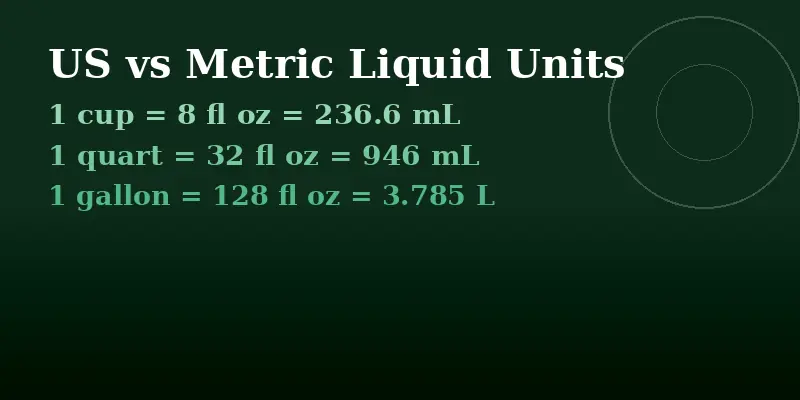
Cups, Ounces, Quarts, and Gallons Through Conversion
The US liquid volume system is built on consistent doubling relationships. Understanding these relationships — rather than memorising individual numbers — is the fastest path to confident volume conversion:
= 4 quarts (32 fl oz each)
= 8 pints (16 fl oz each)
= 16 cups (8 fl oz each)
= 256 tablespoons (½ fl oz each)
= 768 teaspoons (⅙ fl oz each)
The beauty of this hierarchy is that every step is a factor of 2: gallon → half-gallon → quart → pint → cup. This makes halving and doubling any recipe straightforward without needing a separate chart lookup each time.
For a deeper reference on gallons and ounces, see: How Many Water Bottles Make a Gallon?
How to Use a Liquid Measurement Conversion Chart
A liquid measurement conversion chart is most useful when you can read it quickly under practical conditions — in a kitchen, following a recipe, or comparing product sizes at a store. Here is how to get the most out of any volume conversion chart:
Step 1 — Identify Your Starting Unit
Locate the unit you have on the chart. For example, if your recipe calls for "2 cups" and you only have a measuring jug marked in millilitres, find "cups" in the chart first.
Step 2 — Read Across to Your Target Unit
From "1 cup = 236.6 mL," you know 2 cups = 473 mL. Read left-to-right or top-to-bottom depending on the chart orientation, then multiply or divide by your quantity.
Step 3 — Scale by Your Quantity
Charts always show "per 1 unit" values. For larger quantities, multiply. For fractions, divide. Example: recipe needs ¾ cup = ¾ × 236.6 = 177.4 mL.
Step 4 — Cross-Reference for Verification
When precision matters (especially in baking), cross-check by converting back: 177 mL ÷ 29.57 = 5.98 fl oz ≈ 6 fl oz ≈ ¾ cup. Confirmation prevents costly measurement errors in larger batches.
Common Kitchen Conversions You Should Know
These kitchen conversion figures come up so frequently in everyday cooking that memorising them — rather than looking them up each time — meaningfully speeds up recipe work:
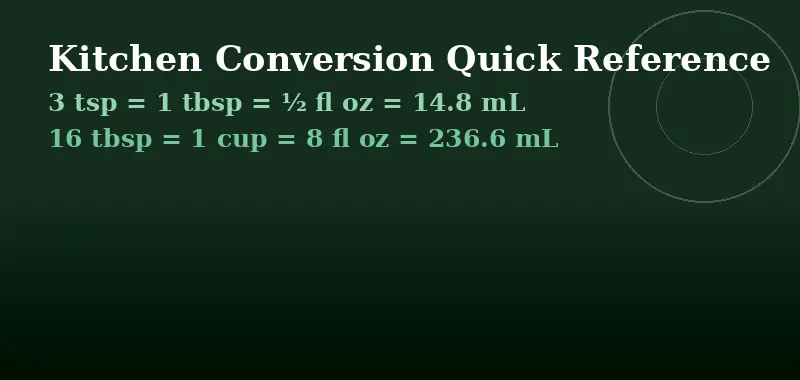
| Conversion | Result | Metric (mL) |
|---|---|---|
| 3 teaspoons | = 1 tablespoon | 14.79 mL |
| 2 tablespoons | = 1 fl oz | 29.57 mL |
| 4 tablespoons | = ¼ cup | 59.15 mL |
| 8 tablespoons | = ½ cup | 118.3 mL |
| 16 tablespoons | = 1 cup | 236.6 mL |
| 2 cups | = 1 pint | 473.2 mL |
| 2 pints | = 1 quart | 946.4 mL |
| 4 cups | = 1 quart | 946.4 mL |
| 4 quarts | = 1 gallon | 3,785 mL |
| 8 cups | = ½ gallon | 1,893 mL |
| 16 cups | = 1 gallon | 3,785 mL |
| 1 liter | ≈ 4.23 cups | 1,000 mL |
| 1 liter | ≈ 33.81 fl oz | 1,000 mL |
US vs Metric Liquid Measurement Differences
The US customary volume system and the metric system (SI) use entirely different foundational units and structures. Understanding why they differ — not just by how much — helps you navigate the conversion chart with confidence.
The US Customary System
US liquid measurements use a base-2 structure built around the gallon: every step up or down is a factor of 2. Gallon → quart (÷4) → pint (÷2) → cup (÷2) → fluid ounce (÷8). The system is intuitive for proportional cooking but awkward for precise scientific measurement because the numbers are not powers of 10.
The Metric System (SI)
The metric system is base-10 throughout. 1 liter = 10 deciliters = 100 centiliters = 1,000 milliliters. Every conversion is a power of 10, which makes arithmetic extremely simple — move the decimal point. A recipe requiring 750 mL is clearly ¾ of a liter; the same quantity in US units (25.36 fl oz or 3.17 cups) requires a table lookup.
Key Comparison Points
- Cup: US cup = 236.6 mL | Metric/UK cup = 250 mL (about 6% larger)
- Gallon: US gallon = 3.785 L | UK imperial gallon = 4.546 L (about 20% larger)
- Fluid ounce: US fl oz = 29.574 mL | UK imperial fl oz = 28.413 mL (about 4% different)
- Pint: US pint = 473 mL (16 fl oz) | UK pint = 568 mL (20 imperial fl oz)
For context on how these differences play out in specific liquid types, see: Oz to Ml Conversion Chart.
The definitive reference for US measurement standards is the National Institute of Standards and Technology (NIST).
Printable Liquid Measurement Chart
A printed liquid measurement conversion chart kept inside a kitchen cupboard door or near the stove is one of the most practical cooking aids. To create one from this page:
- Use your browser's Print function (Ctrl+P or Cmd+P)
- Select Print to PDF to save a digital copy
- In the print dialog, enable Background graphics to preserve the table formatting
- Choose Landscape orientation for wider tables to fit cleanly on a single page
- Print at 100% scale for best readability
Laminating the printed chart makes it kitchen-safe and keeps it readable near sinks and cooking surfaces for years.